What are Your Workplace Health and Safety Obligations, Specifically Around Psychosocial Risks?
Understanding the Latest Amendment and What You Can do to Meet Your Psychosocial Safety Obligations
In recent years, Australia’s workplace safety landscape saw significant shifts when important changes to the Work Health and Safety laws came into place. These changes not only impose legal obligations on businesses but also highlight their corporate social responsibility (CSR) towards employee wellbeing. It’s been a year since changes to Australia’s legislation regarding psychosocial safety at work has taken effect. But, far too few employers know how to comply with these regulations, or even understand the risks in the first place.
What is the legislation?
Under the model WHS laws, businesses, as persons conducting a business or undertaking (PCBU), are now obliged to manage the risks associated with psychosocial hazards in the workplace. This mandate includes identifying and controlling such risks to safeguard the health, safety, and welfare of workers and other individuals involved. The Act provides a framework aimed at eliminating or minimising risks arising from work, stressing the importance of protection against harm.
The recent Work Health and Safety Amendment (Managing Psychosocial Risk and Other Measures) Regulations 2022 reflect a commitment to adopting amendments outlined in the model Work Health and Safety Regulations (model Regulations) by Safe Work Australia. These amendments encompass various measures, including:
- Identifying and controlling psychosocial risks in the workplace.
- Strengthening record-keeping requirements for amusement device operators to enhance safety.
- Clarifying the applicability of standards prescribed by the Act or principal Regulations.
- Updating the list of prescribed public authorities.
- Providing clarity on the coverage for entities exiting the Commonwealth workers’ compensation scheme.
These amendments not only align with the overarching goal of ensuring workplace safety but also underscore the importance of proactive measures in addressing psychosocial risks, which are increasingly recognised as critical factors impacting employee wellbeing and organisational performance.
Shared Responsibility
Employers and workers share responsibility in meeting the new Work Health and Safety (WHS) psychosocial laws. Like managing physical risks, employers must implement and adhere to a risk management process for psychosocial risks.
This involves:
- Identifying potential hazards.
- Striving to eliminate risks where possible.
- Minimising risks if elimination isn’t feasible.
- Maintaining, reviewing, and updating control measures as necessary.
Additionally, workers have obligations to uphold:
- They must take reasonable care for their own psychological and physical health and safety.
- Avoid actions that could harm others’ health and safety.
- Follow reasonable health and safety instructions.
- Cooperate with relevant policies and procedures.
It’s a collective effort to ensure a safe and supportive work environment for all.
What are psychosocial safety hazards in the workplace?
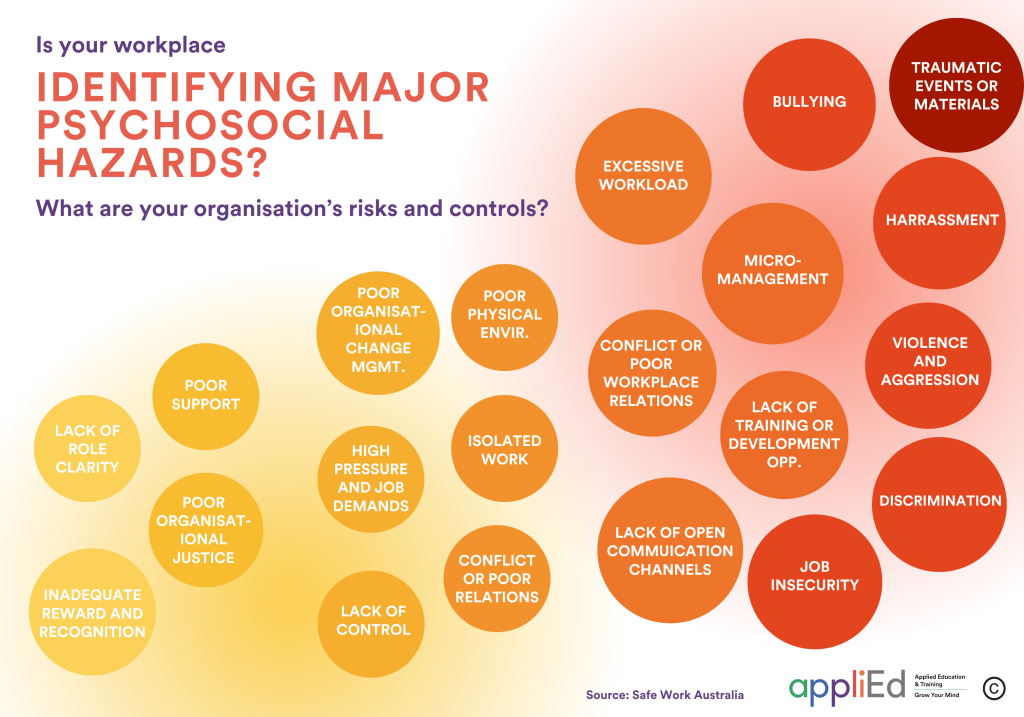
A psychosocial hazard is anything that could cause psychological harm (e.g. harm someone’s mental health). Common psychosocial hazards at work include excessive workload, poor communication channels, lack of training and development, micro-management, bullying, harassment, discrimination or job insecurity to name a few.
What can you do to meet your psychosocial safety obligations?
Risk assessment and management means that organisations conduct comprehensive psychosocial risk assessments to identify potential hazards related to mental health and wellbeing. They then implement risk management strategies to control and mitigate identified risks. This may include modifying work processes, workload management, and providing necessary resources and support.
Organisations also develop and implement clear and comprehensive psychosocial safety policies and procedures that align with WHS legislation and ensure that these policies emphasise the organisation’s commitment to mental health and wellbeing and are communicated to all employees. WHS legislation requires organisations to include their staff in the development of their WHS policies.
We teach the following process to help organsations not only assess and manage risk, but create environments that actively promote greater Mental Fitness and resilience:
Step 1 – Conduct an audit of psychosocial risks in your workplace and Mental Fitness opportunities.
Step 2 – Determine suitable assessment tools
Step 3 – Plan to measure Mental Fitness risks and opportunities.
Step 4 – Undertake research to measure Mental Risks and opportunities
Step 5 – Develop an organisational Mental Fitness strategy.
A Proactive Approach
Investing in training programs such as Applied Education and Training’s 10936NAT Diploma of Mental Fitness and Resilience equips employees with the tools to address psychosocial risks effectively. This comprehensive program delves into identifying psychosocial hazard risks, implementing proactive solutions, and cultivating an environment of resilience and wellbeing (and much more). The practical insights gained from this training can be immediately applied, ensuring that employers comply with WHS laws.
The Diploma from Applied Education & Training (RTO 46114) serves as a valuable asset for companies committed to fostering a culture of wellbeing and safety. By promoting Mental Fitness and resilience, organisations not only comply with legal requirements but also nurture an environment conducive to employee growth and productivity.
Australia’s workplace safety reforms demand a proactive approach to addressing psychosocial risks. By prioritising employee wellbeing and investing in comprehensive training programs, businesses can navigate these changes successfully while building a culture of safety and support. It’s time to embrace a holistic approach to workplace safety that recognises the importance of mental health in the modern workforce.
References:
Safe Work Australia, Snapshot: Psychological health and safety in the workplace (2024). Safe Work Australia. Retrieved April 15, 2024